10. Bulk Control Board
A job runs to process bulk data that use API Dynamic Switch where incoming data goes automatically to be processed as synchronous, batch or bulk. All processed batches are managed on the bulk control board. Bulk Control Board is a dashboard where you can monitor Inbound Processing, Interfaces, and Schedulers. These tabs are using for bulk processing performance. Bulk Control Board is using for mass data. In SKYVVA Bulk Mode user can create upsert, update, insert, and query, query All, pullQuery or delete a large volume of records with the Bulk API, which is optimized for processing large sets of data. It makes it simple to load, update, or delete data over a 5000 records.
SKYVVA Bulk Interface Processing
SKYVVA Bulk Interface Processing is an interface uses for running bulk attachments. When the user has much data, using Bulk Interface Processing is necessary (over 5000 records). Before configuring Bulk Interface Processing, the user has to know about the parameters:
- BULK Mode: Check this flag if you want to run interface in a bulk mode using Salesforce BULK API.
- Bulk Version: We support SFDC pure bulk mode in version 1.0 or 2.0. Then we have our own SKYVVA bulk mode. This uses SKYVVA workflow and mapping and thus is more powerful but slower than the pure bulk API technique from Salesforce. This one is SKYVVA's own bulk mode.
- Bulk Processing Mode: This field indicates the two-mode, which is support with bulk version 1.0. With bulk, version 2.0 only parallel mode is supported. Therefore, the value here depends on the selection of the field bulk version e.g. when we want to use ‘Serial’ then we need to choose ‘Bulk V 1.0’. There are two modes which are:
- Parallel: When you select this processing mode, it will run parallel.
- Serial: When you select this mode, it will not run at the same time.
- Bulk Package Size: This parameter determines how many records are split into Bulk data size. If your Message contains 10.000 records and the value for this parameter is 1000 so the user will get 10 bulk data set in Salesforce.
- Bulk Monitor Keep Size: The number of bulk execute logs to be kept.
- Bulk Sch Frequency: This is the schedule time frequency for the bulk scheduler on the interface.
- Bulk Integrate Time Interval (minute): The interval (minutes) used to integrate bulk job scheduler. For example, if its value is 10, then the integrate bulk scheduler will be run every 10 minutes.
Pre-requisite
Configuring of Bulk Interface Processing This section will be explained by the configuring of Bulk Interface Processing. Assuming you are already created Integration and interface. To understand the process, please follow the steps below:
- Enter Interface page detail
- Scroll down the page to the Streaming and Bulk API Configuration section and configure the parameters as:
- Check the flag on BULK Mode
- Choose the Bulk Version and Bulk Processing Mode

When the user checks this flag, it means you activate the bulk processing and your data will be integrated from Agent. [su_box title="Note" box_color="#2a8af0" title_color="#000000"]After user done configuring the bulk processing, you can do mapping in Salesforce. You have to remember that creating, editing and deleting interface has to do in Salesforce.[/su_box
Monitoring Bulk Control Board:-
Bulk Control Board is located in the Integration page detail and exists in the Custom links section. We use Bulk Control Board to store data temporarily. - Bulk control board is made up of three main section:
- Inbound Processing
- Interfaces
- Scheduler
Inbound Processing
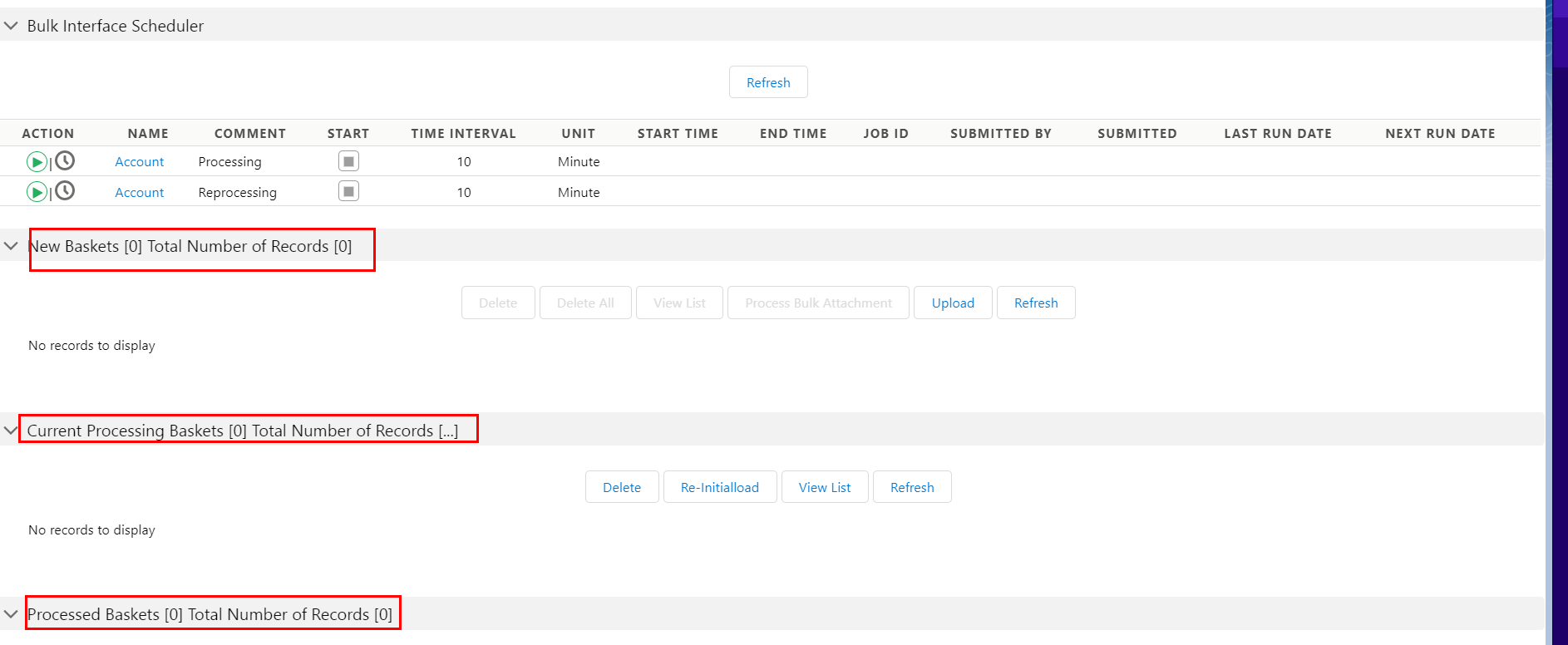
Inbound Processing tabs contain 5 differences sections which are Filter, Bulk Interface Scheduler, Bulk Data Inbox, Bulk Data Processing, and Bulk Monitor. Each section plays different roles in bulk processing. The following will describe in detail each section and how they work. There are Four orders to monitor bulk processing:
- Bulk Interface Scheduler
- New Baskets
- Current Processing Baskets
- Processed Baskets
Filter
The filter is a screen where we can search the baskets. We can filter the baskets based on:
- Integration
- Interface
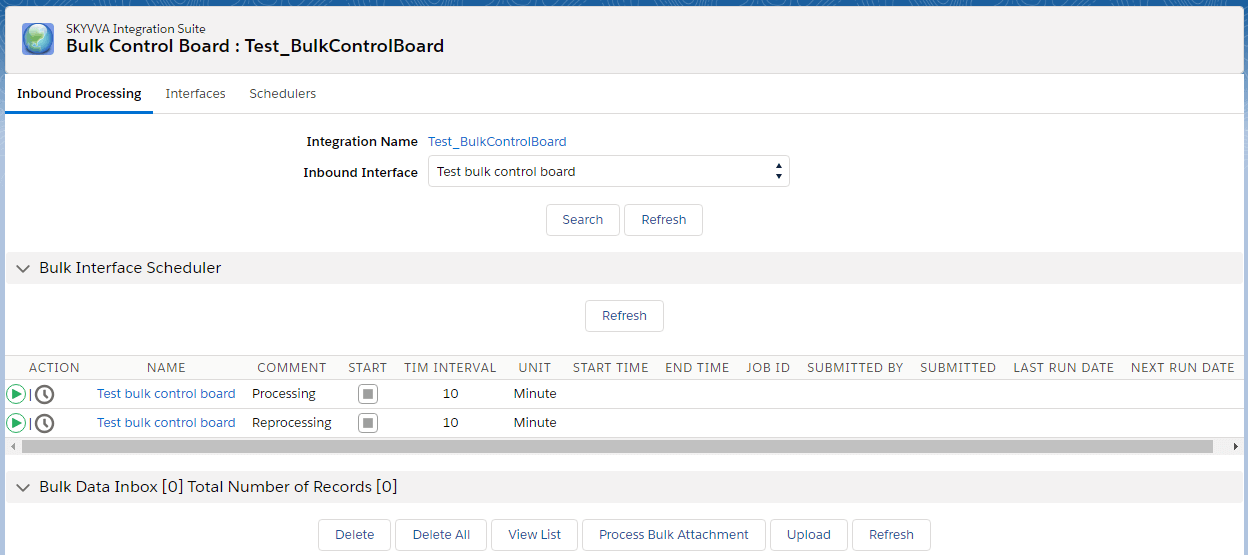
We can apply filer on your Integration and interface and search for the result. It shows as below:
#### Bulk Interface Scheduler
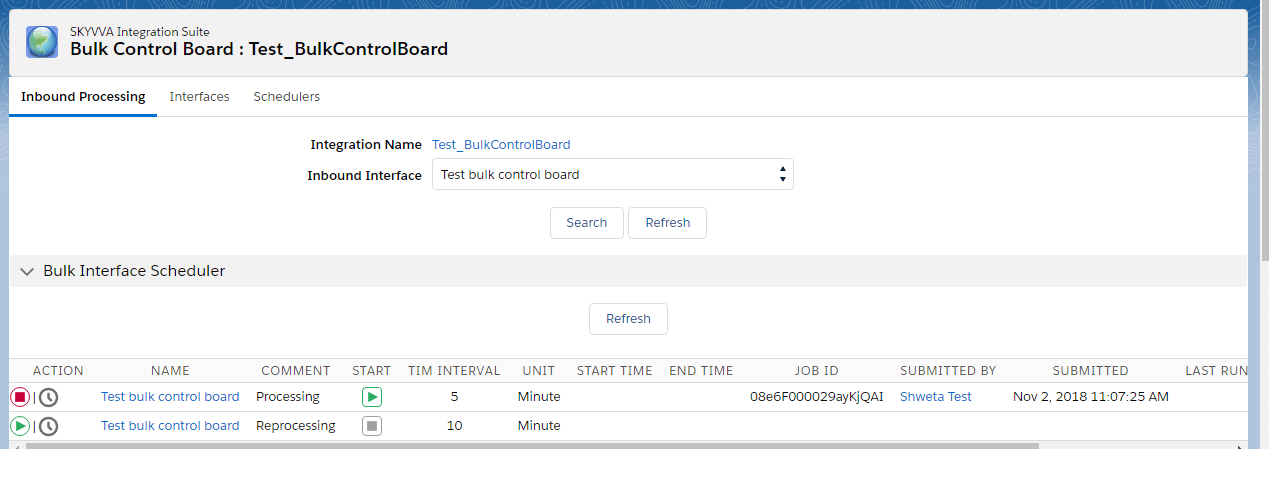
This section uses to monitor two schedulers Processing and Reprocessing. You can only Start/Stop the schedule here. If you want to set the time for your attachment processing, you have to enter the Scheduler tab. It only shows Job Id, Last Run Date, and Next Run Date.
When data pushed from the client using Bulk API, they will appear in this section. This means it contains new incoming data. The bulk processing scheduler will fetch the data from this section and process. So it is a place to store all the attachments which have been integrating from the external system. It contains 6 buttons which are Delete, Delete All, View List, Process Bulk Attachment, Upload, and Refresh. If you want to clear the attachment you can click on Delete and Delete All buttons. To process manually, you
have to click on Process Bulk Attachment. New Baskets####
####
####
####
#### Current Processing Baskets
Bulk Data Processing is used to store data that are processing. These data will remove after it has done to the Bulk Monitor section. Whenever all the attachments that store has faced some problems like crashing you can use the Delete button to eliminate them. But if you want to stop this attachment processing you need to go to Apex job to abort them. Otherwise, the attachment will keep on processing. You can do reprocessing by checkbox and click on the “Re-Initialload” button.
####
####
####
####
Processed Baskets
On the other hand, all the attachments will also move to “Bulk monitor”. In this section, you can monitor the total records of attachments, total batch and batches that had processed. Likewise, you can also know if the attachment is completed, failed or pending.
Interface
List of all interfaces which are processing on batch control board. This tab exhibit the interfaces that store in an Integration. You can facilely check or monitor them. If you land on the Bulk Control board, just simply click on the interface tab then you will visually perceive all the interfaces. However, this tab is not editable like the Interface tab in the Integration detail page.
Scheduler
There are two schedulers available in the Scheduler tab which are 'Attachment Process' and 'Attachment Reprocess '(reprocess the fail annexation). These schedules are for categorical integration. You can set the time and commence the schedule or refresh it.